Table of Content
-
- + more items Show less
The Master of Business Administration degree is one of the most popular postgraduate degrees in India. It is commonly known as MBA. MBA is a two-year postgraduate degree program mainly focused on developing the management, leadership and problem-solving skills in the candidates. The main focus of the program is on teaching case studies and real-world business scenarios to the students. Thereby, preparing them for leadership roles. Other related programs to MBA are PGDM (Postgraduate Diploma in Management), PGP (Post Graduate Program), Master of Management Studies (MMS), Master of Management(MIM) etc.
The applicants applying for MBA should be a graduate in any discipline / science / commerce / humanities / medical / engineering with minimum of 50% marks from a recognized university. But schools require different things of students entering. For example, the top colleges, IIMs and IITs ask for scores in entrance exams of 80-90% marks. CAT, XAT, CMAT, MAT, NMAT, SNAP, GMAT are a few of popular entrance exams for MBA entrance to the university. The subsequent steps after the entrance tests in the admission process are group discussions, personal interviews and written ability test.
MBA colleges in India such as IIMs, IMT, MDI, IIT and B-schools offer various specializations like Finance, Marketing, Operations Management or Human Resources Management among others. The average fee for MBA is between INR 2.00 to 45.00 Lakhs in India.
Some of the MBA jobs that you can pursue are Marketing Manager (MM), Finance Manager (FM), HRM, Product manager (PM), BA and many more. Being MBA graduates, the average salary offered is ₹3.00 to ₹35.00 lakhs per annum. Big recruiting firms are Google, Deloitte, Amazon and Flipkart. There's a high demand for MBA grads, so they tend to have competitive starting salaries and career advancement opportunities.

What is an MBA?
MBA (Master of Business Administration) is a postgraduate degree course that provides the students to hold advanced skills in the business and leadership field needed for managing business. The focus of the program is to give students an understanding of a comprehensive range of roles in business, including finance, marketing, operations and human resource management. MBA is a two year (full time) course. Theoretical Concepts tossed in between MBA has practical learning such as case studies, internships, group projects where candidates are placed into real-life business and made to use what they have learnt.
It’s a significant degree that can provide promising career opportunities for students. MBAs are more likely than undergraduates to hold leadership positions and earn higher salaries. The focus on soft skills that are necessary such as management, how to work in a team, and good communication in business positions. An MBA degree is a life-changing experience for individuals who want to advance in their career and make huge contributions in their industry.
Some specialised MBA programs include Master in Financial Management (MFM), MMS (Master of Management Studies), MMM (Master in Marketing Management) MRM (Master of Risk Management, MIM ), etc.
The MBA degrees can be obtained in institutions where they are approved by the University Grants Commission or UGC. Other organizations, which are neither universities nor affiliated with a university, offer postgraduate diplomas in management (PGDM), which is recognized by AICTE. The Government of India has conferred IIMs and IITs with autonomous status, and they this privileges the power to grant MBA degrees on their own.
IIMs used to have PGDM degrees initially but since IIM Act 2017, they were given the status of ‘Institutes of National Importance’ by Government of India following which they initiated giving MBA degrees from 2018. Also, IITs are autonomous and it is why they can offer MBA degree to students, despite not being a university.
Types of MBA Programs in India
There are various types of MBA to compete as per the career plans, time available and pre-experience. MBA Course in India Types Following are different types of MBA courses in India -Full-Time MBA: This is a 2 year program for freshers and professionals who want to switch their careers. Classroom teaching, internships and exposure to industry inculcates in students a comprehensive awareness of business theories and leadership abilities.
Part-Time MBA: Part time is best for those individuals who wish to work as well as study. It’s often a part-time program that can last up to three years. Subjects are related to MBA course, which is very slow and easy.
Online MBA: Flexibility is the main reason that gave rise to an online MBA program. A student can learn from anywhere, especially working professionals through interactive virtual classes, assignments and projects.
Executive MBA (EMBA): It is a 1-3 year program mainly designed for experienced working professionals. The program focuses on advanced leadership and management issues. Classes can be held full-time, part-time(weekend) or online/distance mode depending on the candidate's schedule.
Integrated MBA: It is a 5-year program combining undergraduate and postgraduate education. It is meant for those who decide at the undergraduate level that they will have a business management career.
Specialised MBA: It is mainly focused on certain industries or functions like Finance, Marketing, HR, Business Analytics, Healthcare Management or IT. It allows students to be experts in any one field.
Global MBA: The main focus of this PG program is to provide an international view of business and management. The objective of these courses is to provide help to students and professionals looking for a career in the global job market or multinational organizations. Typically, the curriculum includes world-class faculty, foreign-born case studies and global networking experiences and study-abroad opportunities.
Reasons to Pursue An MBA Program
MBA is a highly rewarding career choice in terms of career enhancement and personal development. Here are a few reasons why you should opt for an MBA/PGDM program
Career Advancement | Higher Earning Potential |
Diverse Career Opportunities | Skill Development |
Networking Opportunities | Global Perspective |
Entrepreneurial Skills | Credibility and Recognition |
Eligibility For MBA Program
The admission criteria for MBA/PGDM colleges in India varies from college to college. However, the overall criteria of most of the MBA colleges are similar. These requirements are given below:
Educational Qualification: Graduate from acknowledged university (Commerce, Arts or Engineering). For most colleges the minimum criteria is 50% in graduation. Cut Off Marks For the candidates belonging to reserved categories of SC/ST/OBC they need to score 45%-50% marks in an exam. IIMs, IITs require 60% marks.
Entrance Exam: Admission for MBA/PGDM programs generally mandates entrance test results. The popular national-level entrance exams include: CAT, XAT, CMAT, NMAT, GMAT and MAT. However, one can also sit for state-level entrance exams like MAH MBA CET or institution-based entrance examinations like SNAP and NMAT. The cutoff needed usually differs from one college to another.
Work Experience (for Executive MBAs): Previous work experience is required from candidates who want to pursue an executive MBA program. The experience usually spans 2-10 years depending on the given program and institution.
Academic Background Diversity: Many colleges consider educational diversity as a tool to attract applicants from non-business backgrounds like engineering, arts or science to apply.
Additional requirements for admission: Some colleges, while selecting candidates for the MBA program consider the applicants according to their performance in 10th and 12th grade (school board marks), passing marks of graduation, and diversity criteria such as gender, professional or geographical diversity.
Selection Process Round after Entrance Examination: Once the cut-off of entrance exam is out, students go through further selection rounds in the form of Group Discussion (GD), Personal Interview (PI) and Written Ability Test (WAT).
Integrated MBA Course Eligibility: Eligibility For BBA + MBA program, the candidates should have passed 12th standard with at least 50% marks in aggregate and have to clear the entrance examination conducted by the institute/college.
MBA admission eligibility criteria like these ensure that students have an academic base, problem-solving capacity and leadership quality to do well in MBA/PGDM programs.
MBA Eligibility Criteria | Details |
Educational Qualification | Min. 50% score in graduation for the students who belong to the general category (45% score for reserved candidates). IIMs & IITs need 60% marks. |
Entrance Exam | National-level exams like CAT, XAT, CMAT, MAT, GMAT, ATMA and Institute-specific exams like SNAP for symbiosis and NMAT for NMIMS etc. Candidates can also take state-level entrance exams like MAH MBA CET for admission. |
Work Experience | No prior work experience is required for admission to MBA programs. Previous work experience is needed for admission to the EMBA program. |
Academic Diversity | Candidates from diverse educational backgrounds such as engineering, arts or science can also apply. |
Selection Process | After the entrance exam, the selection process includes GD, WAT and PI rounds for admission. |
Additional Requirements | Candidate's performance in 10th and 12th grade, passing marks of graduation and diversity criteria such as gender, professional or geographical diversity. |
MBA Entrance Exams
Most MBAs/PGDMs are conducted via entrance exams. The tests are meant to test the competency and analytical skills of the candidates for management education. Types of MBA entrance exams in India The MBA entrance exam in India is primarily held under three categories, which include national level exams, university level entrance exams and state-level entrance tests. The schedule of these entrance examinations is as follows-
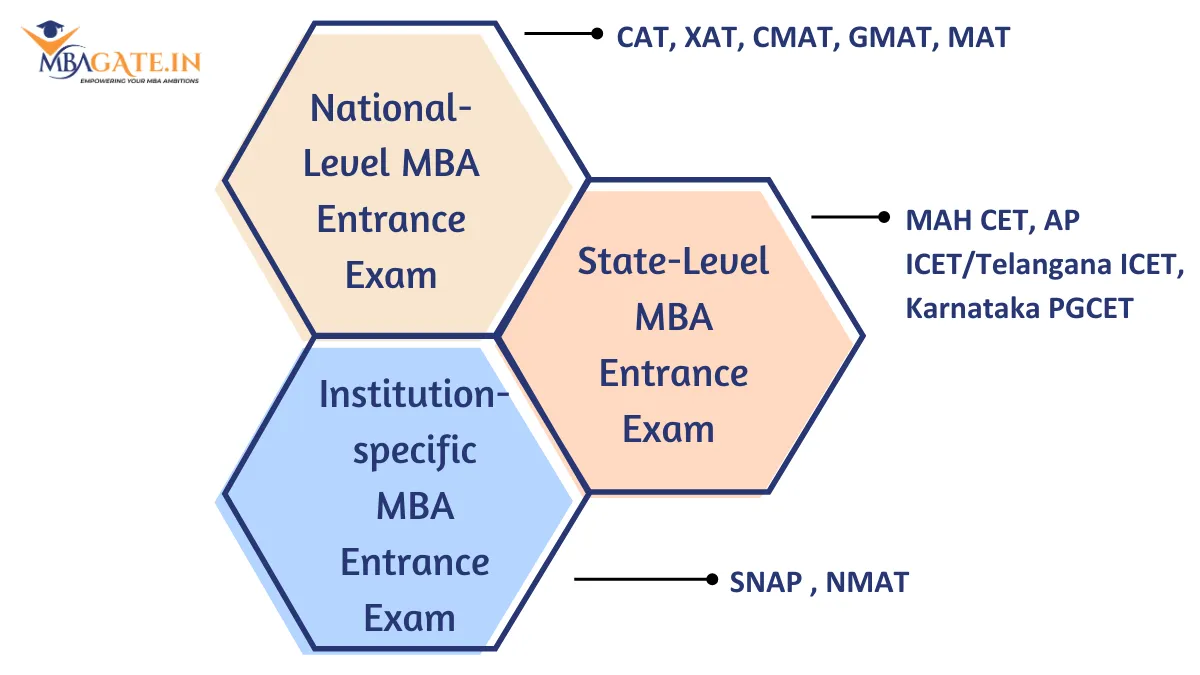
National-level MBA Entrance Exam
These tests are widely accepted by the top management institutes all over India:
Common Admission Test (CAT): IIMs organises this exam and it is the biggest MBA entrance test in India. Here is rest of the parts in Verbal Ability and Reading Comprehension (VARC), Data Interpretation and Logical Reasoning (DILR), Quantitative Ability (QA) To get into IIMs, one has to score a minimum 90 percentile.
Xavier Aptitude Test (XAT): Conducted by XLRI Jamshedpur, XAT is the entrance for pursuing management education at XLRI and over 150 other B-schools. It includes Functionality like Decision Making other than QA, VA and GK.
Common Management Admission Test (CMAT): Exam Pattern The CMAT exam is organized by the National Testing Agency (NTA). CMAT score will be accepted by the AICTE approved institutions. This sections Quantitative Techniques, Logical Reasoning, Language Comprehension, General Awareness and Innovation & Entrepreneurship are conducted to examine a candidate’ skills.
Graduate Management Admission Test (GMAT): It is a global exam and one of the few international examinations that are accepted by leading B-schools in India (ISB, SPJIMR). GMAT scores are good for five years only. It tests the students on Analytical Writing, Integrated Reasoning, Quantitative Ability and Verbal Ability. Now the test is called GMAT Focus Edition.
Management Aptitude Test (MAT): MAT Test for India’s middle level management colleges is conducted by AIMA MAT. The sections are Language Comprehension, Mathematical Skills, Data Analysis & Sufficiency and Reasoning and General Knowledge.
MBA National-Level Entrance Exam | |
CAT | XAT |
CMAT | GMAT |
MAT | |
State-Level MBA Entrance Exam
Given below are some of the popular state-level MBA entrance exams:
MAH CET (Maharashtra Common Entrance Test): Maharashtra is the organizing state for MAH CET and All top MBA colleges in Maharashtra - JBIMS, SIMSREE continue to accept MAH CET scores. It tests Logical Reasoning, Abstract Reasoning, QA and Verbal Ability.
AP ICET/Telangana ICET: This Entrance exam is the gateway for MBA admissions in Andhra Pradesh and Telangana. It is an examination that tests Analytical and Mathematical skills of a candidate.
Karnataka PGCET: For MBA admissions in colleges located in Karnataka. It includes parts on QA, Logical Reasoning, General Knowledge and English.
Institution-specific MBA Entrance Exam
SNAP (Symbiosis National Aptitude Test): It is a national level test which is organized for providing admission in Symbiosis International University’s (SIU) MBA course. It is an examination to check the aptitude of a job seeker in English, Quantitative Aptitude, Reasoning & general Awareness.
NMAT (Narsee Monjee Aptitude Test): Organised by GMAC for admissions into NMIMS and other few colleges. It can be repeated a maximum of three times with the best score taken. The NMAT question paper consists of Quantitative Skills, Language Skills and Logical Reasoning.
CAT Exam Cut-Off
CAT is one of the most challenging entrance exams for seeking admission in top management programs, especially MBA in India at Indian Institutes of Management (IIMs) and other top B-schools. The CAT exam cutoff is the least percentile or score that a candidate requires to fulfill in order to qualify for the further level of the admission process.
Group discussions, written skills tests and interviews are the next round. Institute cut-offs are decided on various factors including number of applicants, availability of seats and performance level of candidates. The cutoffs can also be different for various categories like General Candidate, OBC, SC and ST so that they all get equal opportunity.
IIMs CAT Cut-Off
CAT cut-offs are high for IIMs when they screen candidates for MBA courses. The likes of Ahmedabad, Bangalore and Calcutta IIMs have it between 98-99 percentile while the new ones require around 90-95 percentile to gain an access.
Just clearing the cut-off is no less than a first step because IIMs also consider academics, experience and performance in WAT and PI. + A high CAT Score also works in its favor. Below is the list of 21 IIMs (sorted as per the NIRF ranking 2024) and their cut-offs:
List of IIMs | CAT Cut-Off | List of IIMs | CAT Cut-Off |
IIM Ahmedabad | 99 | IIM Nagpur | 94 |
IIM Bangalore | 99 | IIM Ranchi | 94 |
IIM Calcutta | 99 | IIM Raipur | 94 |
IIM Kozhikode | 97 | IIM Tiruchirapalli | 94 |
IIM Mumbai | 97 | IIM Bodh Gaya | 94 |
IIM Indore | 97 | IIM Sambalpur | 92 |
IIM Lucknow | 97 | IIM Sirmaur | 92 |
IIM Udaipur | 96 | IIM Shillong | 92 |
IIM Rohtak | 96 | IIM Vishakhapatnam | 92 |
IIM Kashipur | 95 | IIM Jammu | 91 |
IIM Amritsar | 90 | ||
Other Institutes CAT Cut-Off
Most of the prominent MBA colleges accept CAT scores with different cut-offs. Premier institutions such as FMS, IIFT and JBIMS have cut-offs of 98-99 percentile and MDI, IITs and XIMB have cut-offs between 85-95 percentile.
Some others like IMT, IMI and Great Lakes have cut-offs of 85-90 percentile but some universities have less stringent requirements. A list of the other business schools is given below along with their CAT cut-offs:
List of Institutes | CAT Cut-Off | List of Institutes | CAT Cut-Off |
FMS Delhi | 98 | IIT Mumbai | 90 |
IIFT Delhi | 98 | IIT Kharagpur | 90 |
MDI | 95 | XIM Bhubaneswar | 91 |
SPJIMR | 85 | IMI New Delhi | 90 |
IIT Delhi | 90 | IMT Ghaziabad | 90 |
Great Lakes Institute Of Management | 85 | FORE School of Management | 85 |
Woxsen University | 70 | JBIMS | 99 |
MBA Admission Process
The admission process for MBA/PGDM programs involves the following:
Eligibility Check: MBA admission eligibility includes a bachelor's degree with 50% marks (45% for reserved categories). Some programs require work experience like the Executive MBA program.
Entrance Exams: Register and appear for MBA entrance tests like CAT, XAT, GMAT, CMAT or state-level exams.
Shortlisting: Colleges shortlist candidates based on entrance exam scores.
Selection Rounds: After the entrance exam the selected candidates are called for further rounds of the selection process. These are Writing Ability Test (WAT) Group Discussion (GD) and Personal Interview (PI). Academic scores, work experience and diversity are also taken into account.
Final Admission: Colleges release merit lists based on candidate’s scores and performance in selection rounds. After the full payment including document verification and orientations, candidates are admitted to the MBA program.
The MBA admission Criteria given above clearly ensures only the eligible and competent candidates get admission into the MBA/PGDM program.

MBA Syllabus
The MBA Syllabus covers a wide range of subjects. These subjects help students gain a solid foundation in business management. Given below are some of the common subjects covered by most of the MBA programs:
MBA Syllabus | Details |
Principles of Management | Basic management of organisations, planning, organising and leadership. |
Marketing Management | Understand markets, customer needs and ways to market products. |
Financial Management | Managing company finances, budgets and investments. |
Accounting for Managers | Fundamentals of financial accounting to support decision making. |
Human Resource Management (HRM) | People management, recruitment, training and employee satisfaction. |
Operations Management | Process, production and supply chain efficiency. |
Business Analytics | The students learn how they can use data to make better business decisions. |
Economics for Managers | Micro and macroeconomics concepts applicable to business. |
Strategic Management | Long-term planning and development of competitive strategy. |
Organizational Behavior | Understanding how individuals and groups behave in organisations. |
Business Communication | Effective communication in the corporate world. |
Legal Aspects of Business | Basics of business laws and regulations. |
Entrepreneurship | The students learn how to start and manage new business ventures. |
Popular MBA Specialisations
Popular MBA Specialisations | |
Marketing Management | Finance Management |
Human Resource Management (HRM) | Operations Management |
International Business | Information Technology (IT) Management |
Business Analytics | Healthcare Management |
Entrepreneurship | Retail Management |
Supply Chain and Logistics Management | Hospitality Management |
Agribusiness Management | Energy and Environment Management |
Public Policy and Administration | Media and Communication Management |
Career Prospects For MBA Graduates in India
MBA graduates in India can opt for a variety of job roles across various industries. These job roles are according to their specialisations and expertise. A list of job profiles for MBA graduates is given below:
MBA Specialisations | Job Roles |
Media Management (MM) | Media Planner, PR Manager & Advertising Account Manager |
Marketing Management | Marketing Manager, Brand Manager, Sales Manager & Digital Marketing Manager |
Finance Management | Financial Analyst, Investment Banker, Risk Manager & Portfolio Manager |
International Business | Export Manager, International Trade Consultant & Global Marketing Manager |
Human Resource Management | HR Manager, Talent Acquisition Specialist, Training & Development Manager |
Operations Management | Operations Manager, Supply Chain Manager, Logistics Manager & Project Manager |
Hospitality Management | Hotel Manager, Event Manager & Tourism Consultant |
Business Analytics | Data Analyst, Business Intelligence Analyst & Analytics Consultant |
IT Management | IT Manager, Systems Analyst, Project Manager & Technology Consultant |
General Management | Business Development Manager, Strategy Manager & Operations Head |
Healthcare Management | Hospital Administrator, Healthcare Consultant & Medical Operations Manager |
Entrepreneurship | Startup Founder, Business Consultant & Venture Analyst |
Retail Management | Retail Manager, Store Manager & Merchandising Manager |
Supply Chain Management | Procurement Manager, Inventory Manager & Logistics Coordinator |
Agribusiness Management | Agribusiness Consultant, Rural Development Officer & Commodity Manager |
Energy Management | Sustainability Manager, Renewable Energy Analyst & Environmental Consultant |
Public Policy | Policy Analyst, Public Affairs Manager & Urban Development Specialist |
Top Sectors Hiring MBA Graduates
Banking & Finance: Investment banks, corporate finance and risk management.
Consulting: Strategic, management and IT consulting positions.
IT & E-commerce: Business analytics, IT management and operations.
Healthcare & Pharma: Hospital management, medical operations and healthcare consulting.
FMCG & Retail: Marketing, sales & operation.
Energy & Infrastructure: Sustainable energy management and project leadership.
Top MBA Colleges in India in the NIRF Ranking 2024
Ranked by NIRF, the top MBA colleges in India ensure world-class education and excellent career prospects. IIM Ahmedabad, Bangalore and Kozhikode are a few of the leading institutes and other notable ones include XLRI, IIT Delhi, IIT Bombay, MDI Gurugram etc with diverse programs between ₹12.00 Lakhs to ₹28.00 Lakhs shaping the future business leaders. The list of the top MBA colleges in India according to the NIRF Ranking is given below:
College Name | NIRF Ranking 24 | Fees |
Indian Institute of Management Ahmedabad (IIMA) | 1 | ₹26.50 Lakhs |
Indian Institute of Management Bangalore (IIMB) | 2 | ₹26.00 Lakhs |
IIM Kozhikode | 3 | ₹20.50 Lakhs |
Indian Institute of Technology Delhi (IIT Delhi) | 4 | ₹12.00 Lakhs |
Indian Institute of Management Calcutta (IIMC) | 5 | ₹27.00 Lakhs |
Indian Institute of Management Mumbai (IIMM) | 6 | ₹21.00 Lakhs |
Indian Institute of Management Lucknow (IIML) | 7 | ₹20.75 Lakhs |
Indian Institute of Management Indore (IIMI) | 8 | ₹21.17 Lakhs |
XLRI-Xavier School of Management (XLRI) | 9 | ₹28.60 Lakhs |
IIT Bombay - Indian Institute of Technology, Bombay | 10 | ₹1.65 Lakhs |
MDI - Management Development Institute, Gurugram | 11 | ₹22.99 Lakhs |
IIM Rohtak | 12 | ₹15.62 Lakhs |
SIBM, Pune | 13 | ₹27.77 Lakhs |
IIM Raipur | 14 | ₹15.62 Lakhs |
IIFT New Delhi | 15 | ₹21.82 Lakhs |
Top Government B-Schools in India: Average Package-Wise
India's best government B-Schools offer quite impressive average packages which truly reflect the standard of education that these institutions deliver and the strong industry connection they have.
The top-tier institutes such as IIM Ahmedabad, Bangalore and Calcutta have averages above ₹34.45 Lakhs per annum and others like IIT Delhi, IIT Bombay and IIM Lucknow report competitive averages at ₹28.00-₹30.00 Lakhs per annum. These institutes act as a gateway for excellent career opportunities for MBA graduates.
College Name | NIRF 2024 Ranking | Average Package |
Indian Institute of Management Ahmedabad (IIM Ahmedabad) | 1 | ₹34.45 Lakhs per annum |
Indian Institute of Management Bangalore (IIM Bangalore) | 2 | ₹35.92 Lakhs per annum |
Indian Institute of Management Kozhikode (IIM Kozhikode) | 3 | ₹28.05 Lakhs per annum |
Indian Institute of Technology Delhi (IIT Delhi) | 4 | ₹28.16 Lakhs per annum |
Indian Institute of Management Calcutta (IIM Calcutta) | 5 | ₹35.07 Lakhs per annum |
Indian Institute of Management Mumbai (IIM Mumbai) | 6 | ₹29.44 Lakhs per annum |
Indian Institute of Management Lucknow (IIM Lucknow) | 7 | ₹30.00 Lakhs per annum |
Indian Institute of Management Indore (IIM Indore) | 8 | ₹25.68 Lakhs per annum |
Indian Institute of Technology Bombay (IIT Bombay) | 10 | ₹28.01 Lakhs per annum |
Top Private Business Schools in India
These top MBA Institutes in India provide outstanding academic programs and excellent placement records. Some of the high-end institutions are XLRI, MDI, XIMB etc that offer excellent MBA programs. These kinds of programs come at a cost range of ₹21.00 to ₹28.00 Lakhs. There are also very good other schools such as SIBM Pune, NMIMS Mumbai, and IMT Ghaziabad which are ranked with high numbers.
College Name | IIRF Ranking 2025 (Private) | Fees |
SPJIMR, Mumbai | 1 | ₹22.50 Lakhs |
XLRI-Xavier Labour Relations Institute, Jamshedpur | 2 | ₹28.60 Lakhs |
MDI-Management Development Institute, Gurgaon | 3 | ₹24.99 Lakhs |
SCMHRD-Symbiosis Centre For Management & Human Resource Development, Pune | 4 | ₹26.06 Lakhs |
NMIMS School of Business Management, Mumbai | 5 | ₹24.00 Lakhs |
SIBM-Symbiosis Institute of Business Management, Pune | 6 | ₹27.77 Lakhs |
IMI-International Management Institute, New Delhi | 7 | ₹22.00 Lakhs |
IMT-Institute of Management Technology, Ghaziabad | 8 | ₹21.53 Lakhs |
Woxsen University, Hyderabad | 9 | ₹21.81 Lakhs |
XIMB-Xavier Institute of Management, XIM University, Bhubaneswar | 10 | ₹23.80 Lakhs |
FAQs
This postgraduate program is for two years. There are some executive or specialised MBA programs that are less than a year old. The part-time MBA may last up to three years.
The decision between an MBA or a PGDM course rests on personal inclinations and aspirations. An MBA is a complete postgraduate course awarded by a university on theoretical knowledge along with the required skills. Whereas PGDM stands for Postgraduate Diploma in Management diploma course by autonomous institutes laying stress on practical skills along with industry applicability.
One of the most crucial factors that the candidates should remember before applying for an MBA or PGDM course is that if they want to pursue higher studies like a PhD then after doing PGDM they need to achieve a master's degree because it is a diploma degree. If it is an MBA then students can be admitted directly in the PhD course after completing their MBA course.
The MBA/PGDM admission procedure involves the following: Check Eligibility, Entrance Exam, Shortlisting, Selection Process which comprises GD, WlAT & PI rounds and Final Admission.